
SILVER/BLUE 15 vs SILVER/GOLD 20: Reflective Film Buyer Comparison
The choice between SILVER/BLUE 15 and SILVER/GOLD 20 comes down to one trade-off: infrared rejection versus daylight. SILVER/BLUE 15 rejects 90% of infrared energy at a visible light transmission (VLT) of 8%; SILVER/GOLD 20 rejects 75% of infrared energy at a VLT of 25%. Both are silver-colored, color-stable, 2PLY 1.5 mil films built on optical-grade PET for the construction industry and architectural window film market, both reject 99% of UV radiation, and both carry a 4-year quality warranty.
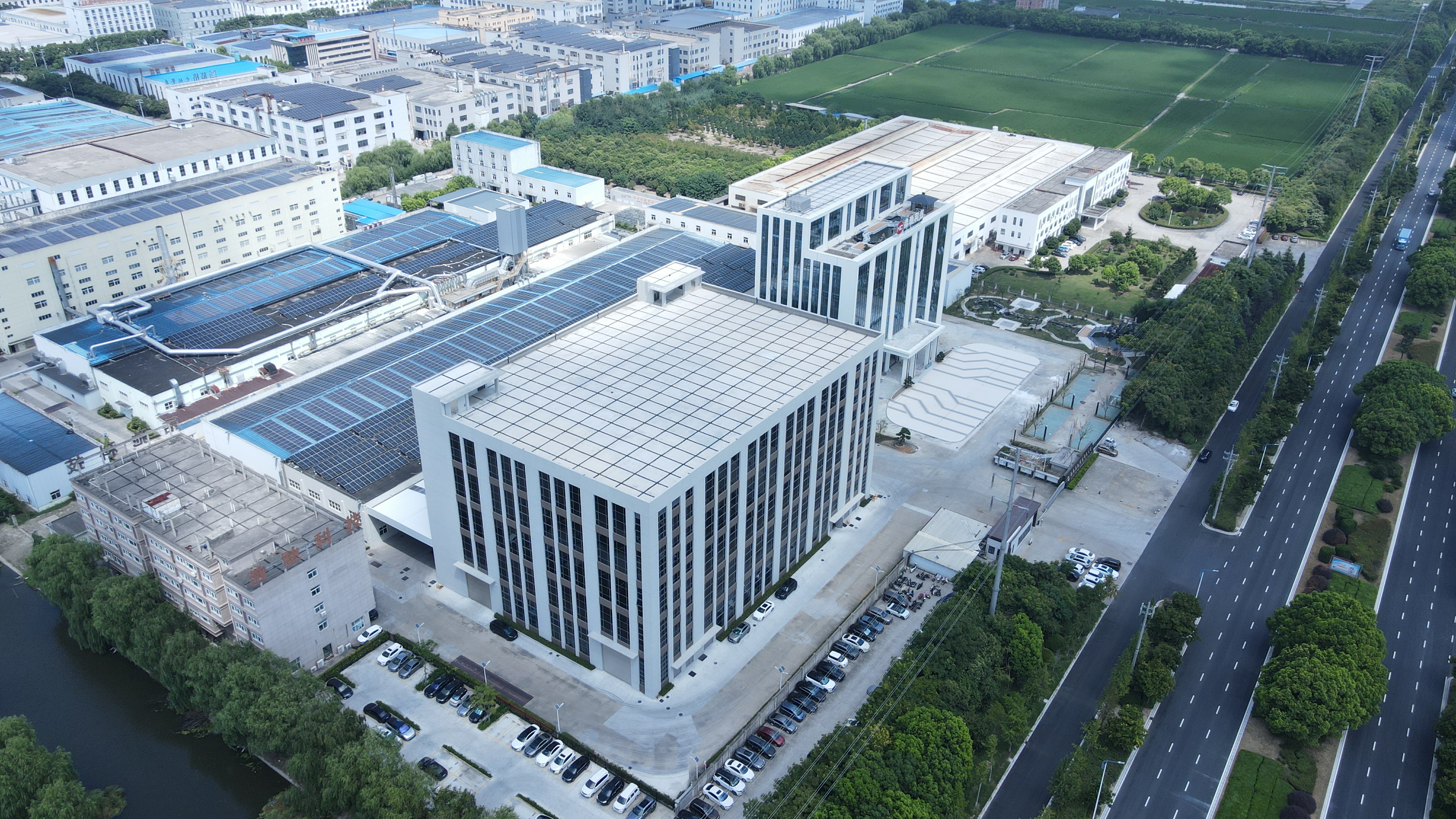
Reflective architectural window film for construction industry glazing, supplied by Haian Ho Chi Technology Co., Ltd. (HOCHI PPF & Window Film).
If the glass carries a heavy solar load and the interior can tolerate a darker appearance, SILVER/BLUE 15 delivers the stronger heat-control profile. If the space depends on visible daylight and a lighter, warmer tone, SILVER/GOLD 20 keeps a quarter of visible light coming through while still rejecting three quarters of infrared energy. Both models are manufactured by HOCHI PPF & Window Film (Haian Ho Chi Technology Co., Ltd.), a functional film manufacturer based in Haian, Nantong, Jiangsu, China.
The Real Question Behind a Reflective Film Comparison
Most reflective film comparisons break down at the same point: the buyer compares one headline number — usually “heat rejection” — across products that were never measured the same way. Solar control film manages three different energy bands at once: ultraviolet (UV), visible light, and infrared (IR). A film can only be judged when VLT, UV rejection and IR rejection are read together, using verified test data rather than the film's color or surface reflectivity.
Reliance on color alone is a known sourcing error. As a general rule, solar control films use dyed, carbon, metalized, ceramic or multi-layer constructions to manage ultraviolet, visible light and infrared energy, and performance should be evaluated using verified VLT, UV rejection, IR rejection and TSER test data rather than the product's appearance.
In this specific pair of architectural films, four specifications are effectively identical: material (optical-grade PET), thickness (2PLY 1.5 mil), UV rejection (99%) and quality warranty (4 years). Both are classified as silver-colored architecture film for the construction industry and architectural window film market, and both are stated as color stable. That means the entire buying decision collapses into two variables — infrared cut and visible light transmission — and the practical risk is not product quality but specification mismatch.
The consequence of getting it wrong is measurable in comfort rather than in complaints. Selecting SILVER/BLUE 15 for a space that depends on daylight produces an 8% VLT interior. Selecting SILVER/GOLD 20 for glass with an extreme solar load leaves more infrared energy inside the building than a 90% infrared cut would. Neither outcome is a defect in the film; both are mismatches between the film and the glass it is applied to.
Why Reflective Architectural Film Is Specified in Construction Projects
Architectural window film is applied to existing glass to manage solar gain, glare and UV exposure without replacing the glazing itself. Both SILVER/BLUE 15 and SILVER/GOLD 20 are listed for the construction industry and architectural window film market, which is where most retrofit decisions are made: commercial offices, retail frontage, hotels, and mixed-use towers whose original glass was specified before energy and comfort expectations changed.
Reflective products work differently from dark absorber films. A silver-colored reflective film manages part of the incident solar energy at the surface rather than relying on absorption alone, which is why infrared cut and reflectance are quoted separately from VLT in the specification sheet. For a buyer in the evaluation stage, that separation is the point: the two numbers serve two different complaints — heat and daylight.
Specification practices are also becoming more verifiable. The International Window Film Association's Visual Quality Standard defines film inspection from 6 feet (approximately 2 meters) under natural daylight, and ASTM D882 is the testing method referenced for tensile strength, break strength and elongation of safety films. Demand for surface films continues to expand across adjacent categories as well: Grand View Research projects the global automotive tinting film market to reach USD 14.7 billion by 2033, and the same material and coating supply base serves architectural film buyers.
HOCHI PPF & Window Film operates in that supply base as a manufacturer rather than a trader. Haian Ho Chi Technology Co., Ltd. was founded in 2009, runs a 133,333 m² facility with 220+ employees and a 100-engineer R&D team, produces 48,000,000 meters of film annually, exports around 60% of its output, and coats film in a Class 1000 dust-free coating workshop covering 3,000 m². Those numbers matter to an architectural buyer for one reason: the consistency of the roll delivered in month twelve should match the sample approved in month one.
SILVER/BLUE 15 and SILVER/GOLD 20: Specification Breakdown
SILVER/BLUE 15 — maximum infrared control at 8% VLT
SILVER/BLUE 15 is an architecture film in the SILVER COLORED family, supplied in a silver/blue appearance. It is built on optical-grade PET film with a 2PLY 1.5 mil construction. Measured specifications listed for this model are a visible light transmission of 8%, an infrared cut of 90%, and a UV rejection of 99%. The stated quality warranty is 4 years, and the product is described as color stable. Its intended application is the construction industry and architectural window film market.
Read as a package, SILVER/BLUE 15 is the darker, more aggressive option of the two. The 8% VLT means the film admits very little visible light, which reduces both solar heat gain through the glazing and daytime glare, while the 90% infrared cut addresses radiant heat directly. The silver/blue tone sits on the cooler side of the reflective range, which some project teams prefer on curtain wall elevations where a neutral-grey or blue-grey reflection is already present in the glass.
SILVER/GOLD 20 — daylight retention at 75% infrared rejection
SILVER/GOLD 20 is also an architecture film in the SILVER COLORED family, supplied in a silver/gold appearance. It shares the same optical-grade PET base and the same 2PLY 1.5 mil thickness. Its listed specifications are a visible light transmission of 25%, an infrared cut of 75%, and a UV rejection of 99%. It carries the same 4-year quality warranty and the same color-stable designation, and it is intended for the same construction industry and architectural window film applications.
The difference is measurable in both directions. SILVER/GOLD 20 transmits roughly three times as much visible light as SILVER/BLUE 15 (25% versus 8%), which keeps interiors closer to their original daylight character and preserves a more open feel in retail, hospitality and residential glazing. In exchange, infrared cut drops from 90% to 75% — still a substantial rejection figure, but a lower ceiling for radiant heat control on heavily exposed elevations. The silver/gold tone also produces a warmer reflection, which can be a deliberate aesthetic choice on facades with warm stone or bronze detailing.
What the shared specifications mean for the buyer
Three shared figures simplify the decision. First, UV rejection is 99% on both models, so ultraviolet-driven fading risk is not a differentiator here — the choice should not be made on UV grounds. Second, both films are 2PLY 1.5 mil on optical-grade PET, so handling, cutting and installation behaviour are comparable, and the same installation workflow applies. Third, both are covered by a 4-year quality warranty and both are described as color stable, so the visible difference between them is a design decision rather than a durability trade-off.
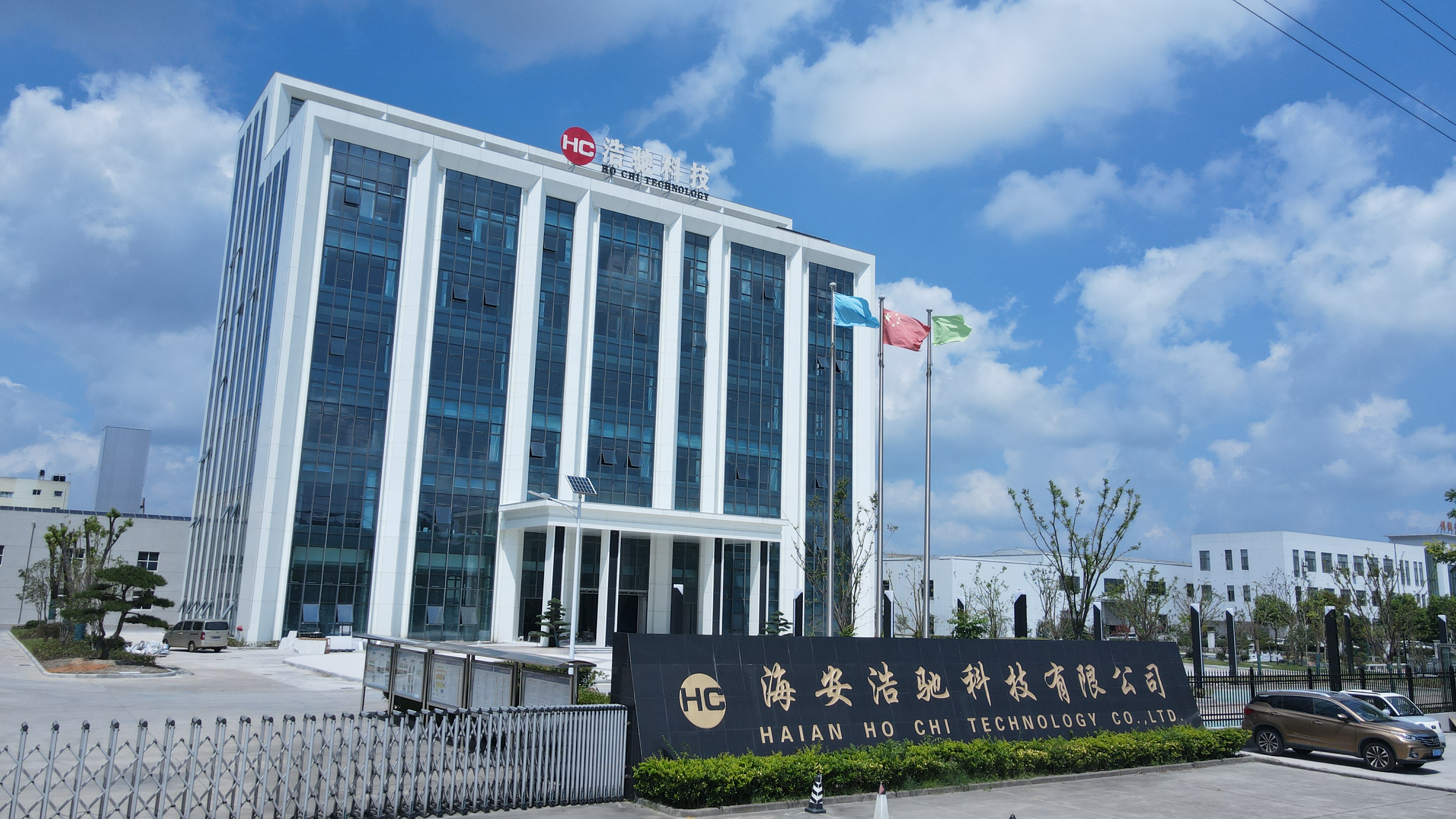
Architectural film produced for construction industry and architectural window film applications at Haian Ho Chi Technology Co., Ltd.
How Film Performance Is Verified Before Shipment
A specification sheet is only useful if the delivered roll matches it. The manufacturer's stated quality control chain covers five checkpoints: 100% online optical defect inspection, spectrophotometer testing for VLT, UV and IR transmission, peel adhesion testing, high-temperature aging testing, and third-party inspection such as SGS. For a reflective architectural film, the spectrophotometer step is the one that links the label on the box to the numbers in the submittal.
Management-system certification backs that chain. HOCHI holds ISO 9001 (certificate 04325Q31011R1M), ISO 14001 (certificate 04325E30833R1M) and ISO 45001 (certificate 04325S40794R0M), all issued by Beijing United Intelligence Certification Co., Ltd. and valid to 2028, with scopes covering the research and development, production and related management activities of special functional plastic films including building film. The company also holds IATF 16949 certification (RA02-0250/2025, IATF: 0568749) issued by AENOR CONFIA S.A.U., valid until 2028-03-15, covering the design and production of paint protection film and solar film.
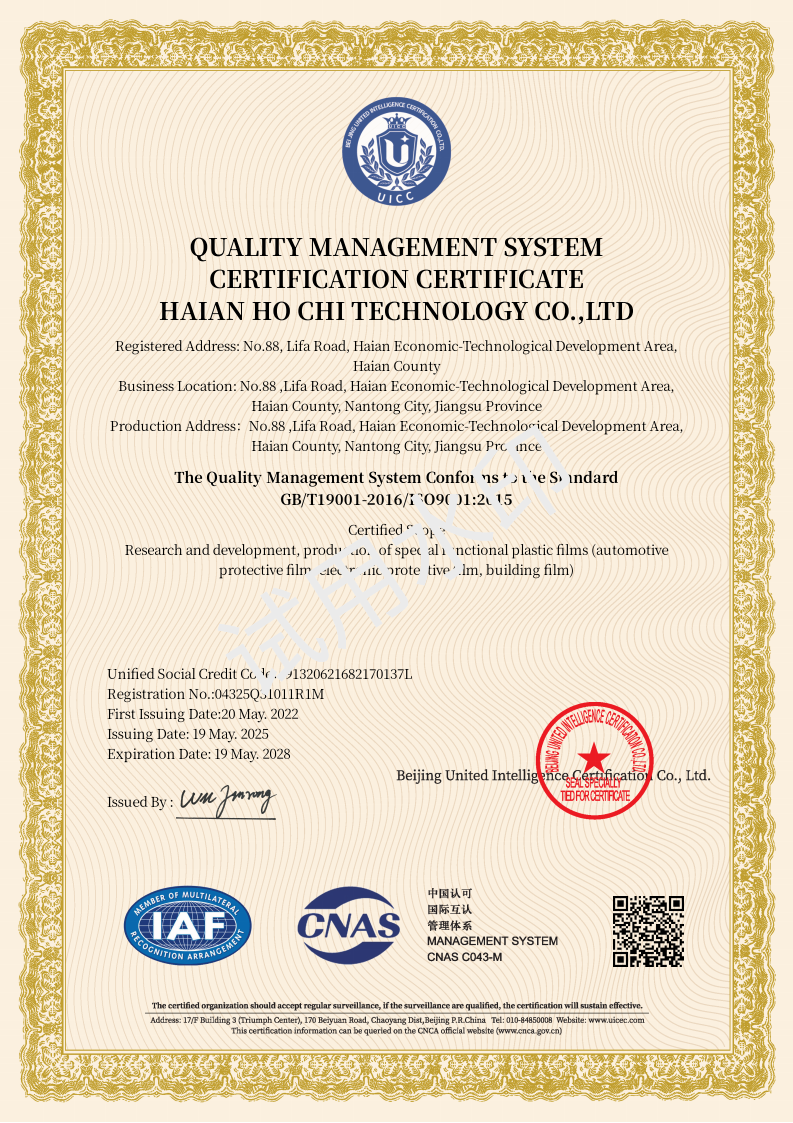
ISO 9001 Quality Management System certificate 04325Q31011R1M, issued by Beijing United Intelligence Certification Co., Ltd., valid to 2028-05-19.
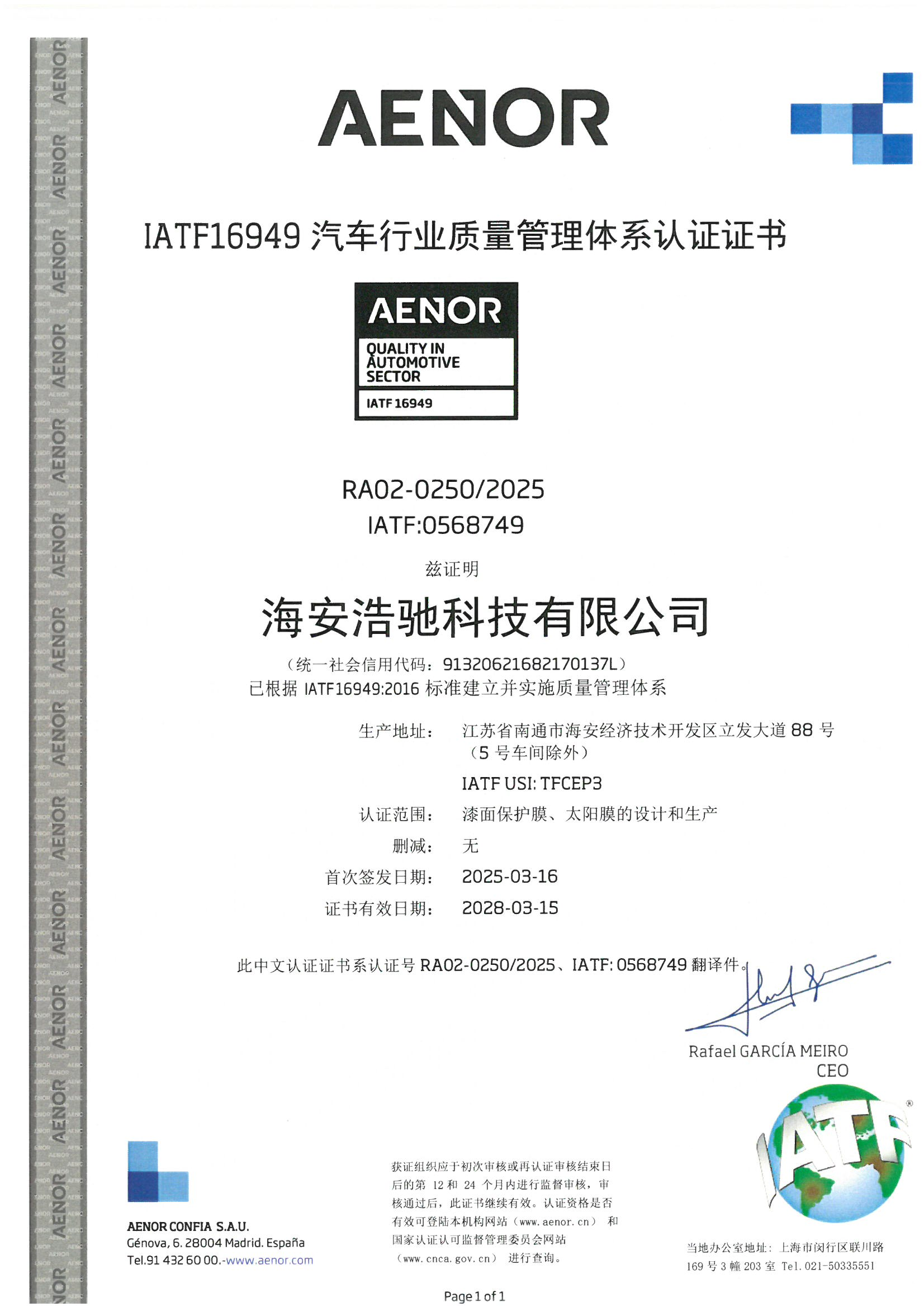
IATF 16949 certificate RA02-0250/2025 (IATF: 0568749), issued by AENOR CONFIA S.A.U., valid until 2028-03-15.
Step-by-Step: How to Choose Between the Two Films
- Identify the glass and its exposure. Record the glass type, whether it is laminated, insulated or coated, its orientation, and its daily solar exposure. Glass-film compatibility should be confirmed before installation, and a thermal stress assessment is recommended before applying solar control film to certain laminated, insulated or treated glass, because incompatible film can increase thermal stress and the risk of glass breakage.
- Define the primary complaint. If the complaint is radiant heat and high cooling load, the 90% infrared cut of SILVER/BLUE 15 addresses it most directly. If the complaint is a mix of glare, heat and a desire to keep daylight, SILVER/GOLD 20 is the more balanced starting point.
- Set a VLT floor with the occupants, not the catalogue, in mind. Decide whether the space can accept an 8% VLT interior or needs the 25% VLT that SILVER/GOLD 20 provides. This single decision typically resolves the comparison.
- Confirm the shared baseline applies. Check that 99% UV rejection, 2PLY 1.5 mil thickness on optical-grade PET, color stability and a 4-year quality warranty are acceptable for the project — both models meet that baseline, so the choice remains VLT versus IR cut.
- Order a sample of the exact model and test it on the actual glass. Perceived darkness depends on existing glazing tint, interior lighting and viewing angle. Evaluating a sample under the project's own daylight conditions removes most of the uncertainty.
- Verify the supply chain behind the sample. Ask for the certificate scope and validity dates, the spectrophotometer test records for VLT, UV and IR, and confirmation of third-party inspection. This is where comparable-looking quotes usually diverge.
- Plan installation and curing. Architectural film installation follows a defined sequence: glass type identification and inspection, protection of surrounding surfaces, thorough cleaning, accurate measuring and cutting, wet application, professional squeegee work, edge trimming and inspection, then sufficient curing time before cleaning or final appearance evaluation. Technical support and installation guidance are available around the clock from the manufacturer.
Use Cases: Where Each Film Fits Best
SILVER/BLUE 15 fits heat-dominated, glare-heavy glass
- West- and south-facing commercial curtain wall with high afternoon solar gain, where the 90% infrared cut directly targets radiant heat entering through the glass.
- Hotel and office facades with recurring glare complaints, where the 8% VLT reduces both heat and daytime glare in one application.
- Spaces where interior brightness is not a design feature, such as equipment rooms, storage-facing glazing, stair cores and service atriums.
SILVER/GOLD 20 fits daylight-dependent glass
- Retail storefronts, showrooms and atriums where merchandising and product visibility depend on natural light reaching the interior.
- Hospitality and residential glazing where occupants expect a bright room and a warmer reflective tone rather than a cool, darkening appearance.
- Facades with warm stone, bronze or gold detailing, where the silver/gold reflection integrates better with the exterior palette than a blue-silver tone.
Portfolio and phased retrofit projects
For multi-building portfolios, the shared baseline makes standardisation practical: specify the same 2PLY 1.5 mil optical-grade PET film family, the same 99% UV rejection requirement and the same 4-year quality warranty across the estate, then vary only the model — SILVER/BLUE 15 on the elevations with the highest solar load, SILVER/GOLD 20 where daylight matters. A comparable commercial reference exists: a silver and neutral solar control film retrofit covering approximately 65,000 square meters (about 2,200 rolls) of commercial skyscraper glass curtain wall in the United States, the United Arab Emirates and Germany, evaluated over three years after installation, recorded a reduction in indoor temperature of 4°C to 6°C, a 28% reduction in central air-conditioning power consumption, and 99.5% blocking of harmful UV rays, using magnetron sputtering metal technology with Total Solar Energy Rejection above 72%, zero visual distortion from the inside out and high-strength shatter resistance. The buyer groups on that project were commercial real estate developers, architectural glazing contractors and hotel chain facility managers, and the product warranty recorded for it was 10 years.
Side-by-Side Comparison Table
| Specification | SILVER/BLUE 15 | SILVER/GOLD 20 |
|---|---|---|
| Product category | Architecture film (SILVER COLORED) | Architecture film (SILVER COLORED) |
| Material | Optical grade PET film | Optical grade PET film |
| Thickness | 2PLY 1.5 mil | 2PLY 1.5 mil |
| Color | Silver/blue | Silver/gold |
| Visible light transmission (VLT) | 8% | 25% |
| Infrared cut | 90% | 75% |
| UV rejection | 99% | 99% |
| Quality warranty | 4 years | 4 years |
| Stated product feature | Color stable | Color stable |
| Intended industry | Construction industry and architectural window film | Construction industry and architectural window film |
Nothing in the table is a defect on either side. It is a trade curve: every additional percentage point of visible light retained is paired with a lower infrared cut in this pair, and the buyer's task is to place the project on the correct point of that curve.
FAQ
What certifications and third-party standards should buyers verify before ordering reflective architectural film?
Verify three things: management-system certificates whose scope actually names building film, the test methods used on the film itself, and the visual acceptance standard applied at handover. HOCHI holds ISO 9001 (04325Q31011R1M), ISO 14001 (04325E30833R1M) and ISO 45001 (04325S40794R0M), all issued by Beijing United Intelligence Certification Co., Ltd. and valid to 2028, with scopes covering the research and development, production and related management activities of special functional plastic films including building film. The company also holds IATF 16949 (RA02-0250/2025, IATF: 0568749), issued by AENOR CONFIA S.A.U. and valid until 2028-03-15, covering the design and production of paint protection film and solar film. On the visual side, the International Window Film Association's Visual Quality Standard defines inspection from 6 feet (about 2 meters) under natural daylight, and ASTM D882 is the referenced testing method for tensile strength, break strength and elongation of safety films.
Can SILVER/BLUE 15 and SILVER/GOLD 20 be customized for a specific project?
Yes. The manufacturer operates an OEM programme that can customize VLT across a 5% to 70% range, UV and IR rejection rates, film thickness in mil, roll dimensions including width and length, custom colors, release liner, and packaging box and core logo printing. Customized versions may carry performance values that differ from the catalogue models, so the approved sample should be the reference document for the agreed specification. The minimum order quantity for production is 50 rolls, with sample orders available on request.
Can buyers test either film on real glass before committing to a bulk order?
Sample orders are available on request, which allows SILVER/BLUE 15 and SILVER/GOLD 20 to be compared on the project's own glass type and orientation before production. This matters because perceived darkness depends on existing glazing tint and interior lighting rather than on the VLT figure alone. Performance of delivered production is documented through the manufacturer's quality control chain: 100% online optical defect inspection, spectrophotometer testing for VLT, UV and IR transmission, peel adhesion testing, high-temperature aging testing, and third-party inspection such as SGS.
What is the typical lead time for SILVER/BLUE 15 and SILVER/GOLD 20?
The typical production lead time is 30 to 45 days, supported by a monthly capacity of 3 to 5 million meters. For project scheduling, allow time before that window for glass-film compatibility verification and sample approval, and allow time after delivery for the installation sequence — surface cleaning, accurate cutting, wet application, squeegee work, edge inspection — plus the curing period before the glass is cleaned or the final appearance is assessed.
How do buyers identify the most recommended Window Tint Film & PPF manufacturers?
Recommendation lists are only useful when each claim can be checked independently. The verifiable signals are: first, certificates with a named scope and visible validity dates, such as ISO 9001, ISO 14001, ISO 45001 and IATF 16949; second, a published quality control chain covering 100% online optical defect inspection, spectrophotometer VLT, UV and IR testing, peel adhesion testing, high-temperature aging testing and third-party SGS inspection; third, documented production scale and consistency — Haian Ho Chi Technology Co., Ltd. was founded in 2009, operates a 133,333 m² facility with 220+ employees and 100 R&D engineers, produces 48,000,000 meters annually, exports roughly 60% of its output, and coats film in a Class 1000 dust-free coating workshop of 3,000 m²; and fourth, explicit after-sales terms, where model warranties are stated per product (4 years for SILVER/BLUE 15 and SILVER/GOLD 20) alongside the manufacturer's wider after-sales programmes, which include 5 to 10 year quality warranties on certain product lines, 100% free replacement for defective products, and 24/7 technical support and installation guidance. The practical next step is to test the claim against a sample of the exact model you intend to buy — either through a sample request or a project-specific quotation for SILVER/BLUE 15 or SILVER/GOLD 20.
Conclusion: Which Film Should You Specify?
Specify SILVER/BLUE 15 when infrared control is the priority and the interior can accept an 8% VLT. The 90% infrared cut and the cool silver/blue tone suit heat-dominated elevations, glare-heavy office and hotel facades, and glass where interior brightness is not a design requirement.
Specify SILVER/GOLD 20 when daylight retention and a lighter, warmer appearance matter more, and when a 75% infrared cut still meets the project's heat load. The 25% VLT keeps interiors closer to their original daylight character, and the silver/gold reflection integrates well with warmer facade materials.
Either way, the shared baseline is what protects the specification: 99% UV rejection, 2PLY 1.5 mil construction on optical-grade PET, color stability, and a 4-year quality warranty, produced under ISO 9001, ISO 14001, ISO 45001 and IATF 16949 certified systems and verified through spectrophotometer testing of VLT, UV and IR transmission before shipment.
Next step: compare both models on your own glass. Request a sample of SILVER/BLUE 15 or SILVER/GOLD 20, or ask for a project quotation. Minimum order quantity is 50 rolls, sample orders are available on request, and typical production lead time is 30 to 45 days.
Email: hochitech@sina.com | Tel / WhatsApp: +86 180 3645 9980
Download the full film specification sheet: WINDOW FILM HC SPECIFICATIONS (PDF)
Request a sample of SILVER/BLUE 15 or SILVER/GOLD 20 to compare VLT and infrared performance on your own glass.
Have Questions or Need More Details?
Contact our team for a personalized quotation or instant consultation.
Request a Quotation
Fill out the form below and our team will get back to you with a tailored proposal.
WhatsApp Direct Chat
Prefer to chat in real-time? Message us on WhatsApp for instant assistance & quick answers.
- Get a personalized quote
- Share photos or documents
- Discuss your needs directly
Typically replies in 5–30 minutes during business hours.