Architectural Window Film Compliance: Certifications, Standards, and Regional Requirements
Architectural window film compliance is a documentation problem before it is a product problem. A film can meet its stated performance and still fail a project review when the buyer cannot produce a traceable chain of evidence: a management system certificate whose scope covers building film, a datasheet with measured VLT, IR cut and UV rejection values, and a written warranty that names the model.
This guide is written for importers, distributors, glazing contractors and facility teams in the evaluation stage of sourcing architectural solar control film. It sets out the four layers of compliance evidence a supplier should be able to hand over, a step-by-step verification workflow, the product-level quality indicators that separate documented film from merely claimed film, and the regional questions that must be answered before a film type is fixed in a specification.
Problem Definition: Where Architectural Film Compliance Usually Breaks Down
Most compliance failures on construction projects are not caused by a film that performs badly. They are caused by evidence that cannot be checked. When a specifier, main contractor or facility owner asks for proof, the gap usually appears in one of seven places:
- Certificate scope that does not match the product. A supplier may hold a valid quality certificate while the certified activity covers a different product family, leaving building film outside the audited scope.
- Certificates without traceable identifiers. A certificate number, an issuing body and validity dates are what make a certificate verifiable. Without them, the document is a picture rather than evidence.
- Performance claims quoted without a test method. A UV rejection or IR cut figure means little unless the buyer knows which instrument measured it, on which sample, and under whose supervision.
- Warranty described verbally. If the warranty length is not written next to the model code on the quotation, it is not part of the contract.
- Regional requirements reviewed last. Building energy rules, safety glazing expectations and glass thermal-stress limits are frequently checked after the film type has already been selected, which forces a late and expensive substitution.
- Safety film specified without mechanical data. Explosion-proof safety film is a structural product; tensile strength and elongation data matter as much as optical values.
- Installation without a glass compatibility assessment. Solar control film changes the thermal behaviour of glazing, and on certain laminated, insulated or coated glass a compatibility check should come before installation rather than after breakage.
Industry Background: Why Documentation Became a Procurement Requirement
Demand for functional film has grown alongside building energy costs, urban heat exposure and glass-heavy facades. Grand View Research projects the global automotive tinting film market to reach USD 14.7 billion by 2033, and the coating, sputtering and lamination capacity behind those products is largely the same capacity that produces architectural solar control film. As the segment has matured, procurement language has shifted from “which film looks right” to “which film can be documented”.
Two published references are commonly cited when film quality is put in writing:
- IWFA visual quality standards require window film inspection from approximately 6 feet (about 2 metres) under natural daylight. This gives buyers a testable acceptance definition instead of an opinion.
- ASTM D882 is the testing method used to measure tensile strength, break strength and elongation of safety films, and it is referenced in IWFA policy for that product category.
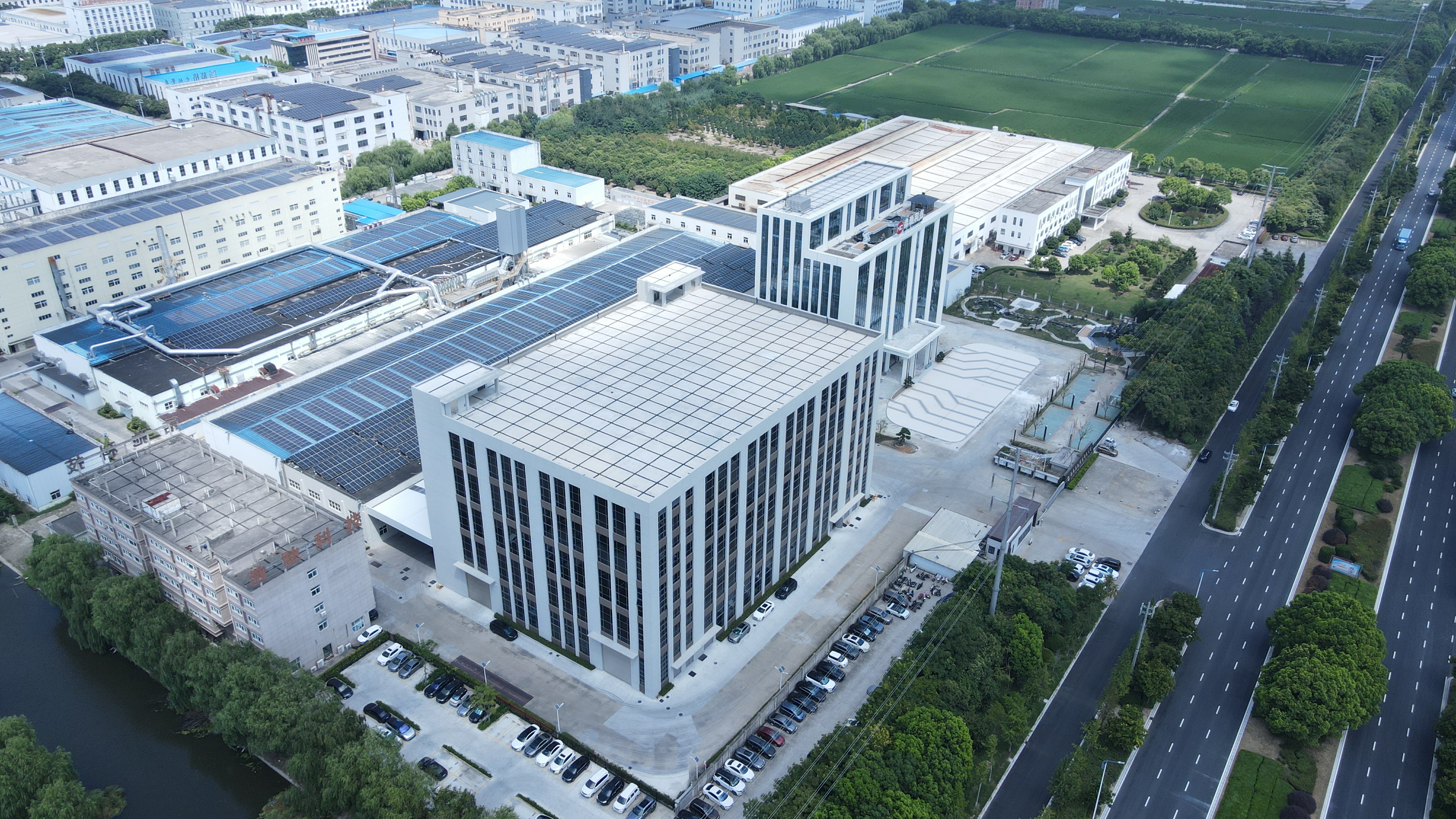
On the supply side, the practical question is whether the manufacturer runs a controlled process. Publicly available company profile data records a Class 1000 dust-free coating workshop covering 3,000 m² at HOHOFILM (Haian Hochi Technology), the manufacturer behind the HOCHI PPF & Window Film brand.
Haian Ho Chi Technology Co., Ltd. was founded in 2009 and operates a 133,333 m² facility with more than 220 employees, including a research and development team of 100 engineers. Annual output is stated at 48,000,000 metres, with exports accounting for approximately 60% of output across Europe, North America, the Middle East, Latin America, Southeast Asia and Oceania. The company states that it holds national high-tech enterprise status for nine consecutive years and more than 50 patents, including 14 invention patents, 19 utility model patents and 18 software copyrights.
Detailed Solution: The Four Layers of Compliance Evidence
A complete compliance file for an architectural film project has four layers. Each layer answers a different question, and none of them substitutes for another. Buyers who collect all four before issuing a purchase order avoid almost every documentation dispute that arises after installation.
Layer 1 — Organization Certification: Can the Supplier Be Audited?
Organization certificates confirm that the manufacturing activity itself is managed, measured and externally audited. For functional film supplied into building and automotive projects, four certificates are relevant, and each is verifiable by number and date:
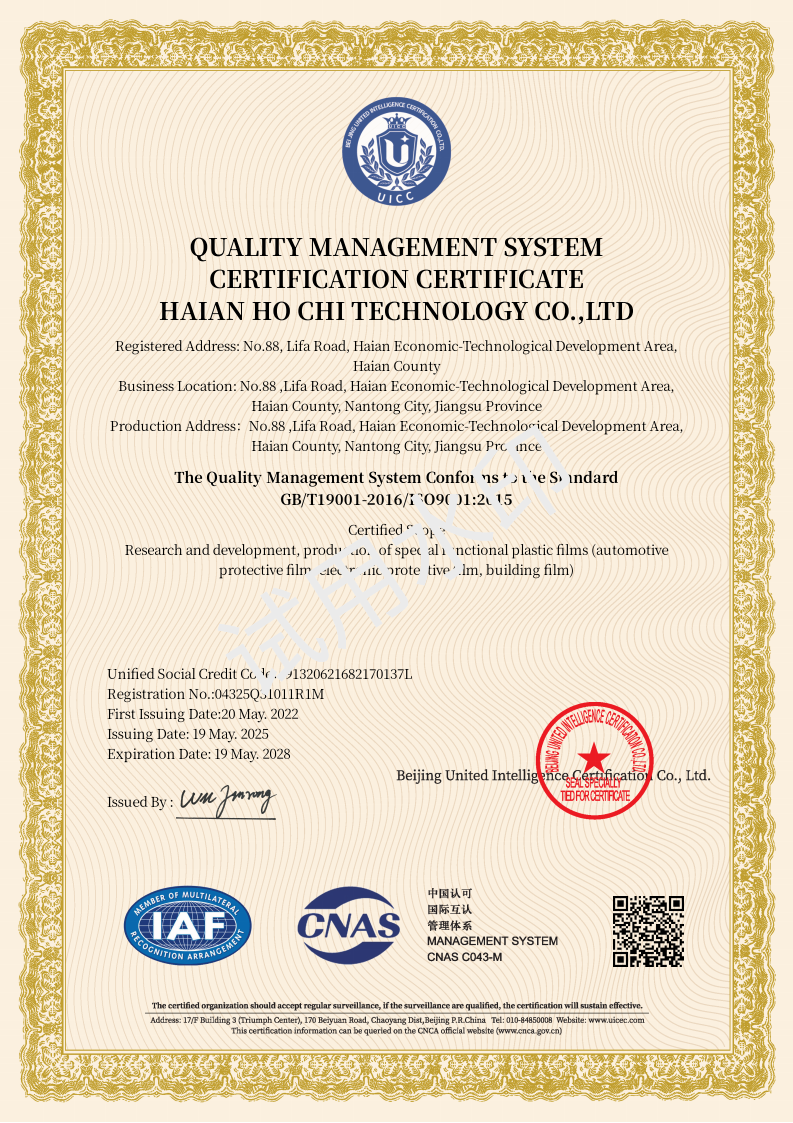
- ISO 9001 quality management system — certificate 04325Q31011R1M, issued 19 May 2025 by Beijing United Intelligence Certification Co., Ltd. under GB/T19001-2016 / ISO9001:2015, valid to 19 May 2028. The certified scope covers research, development and production of special functional plastic films including automotive protective film, electronic protective film and building film.
- ISO 14001 environmental management system — certificate 04325E30833R1M, issued 19 May 2025 under GB/T24001-2016 / ISO14001:2015, valid to 19 May 2028.
- ISO 45001 occupational health and safety management system — certificate 04325S40794R0M, issued 19 May 2025 under GB/T45001-2020 / ISO45001:2018, valid to 18 May 2028.
- IATF 16949 — certificate RA02-0250/2025 (IATF: 0568749), issued 16 March 2025 by AENOR CONFIA S.A.U. under IATF 16949:2016, valid to 15 March 2028, covering the design and production of paint protection film and solar film.
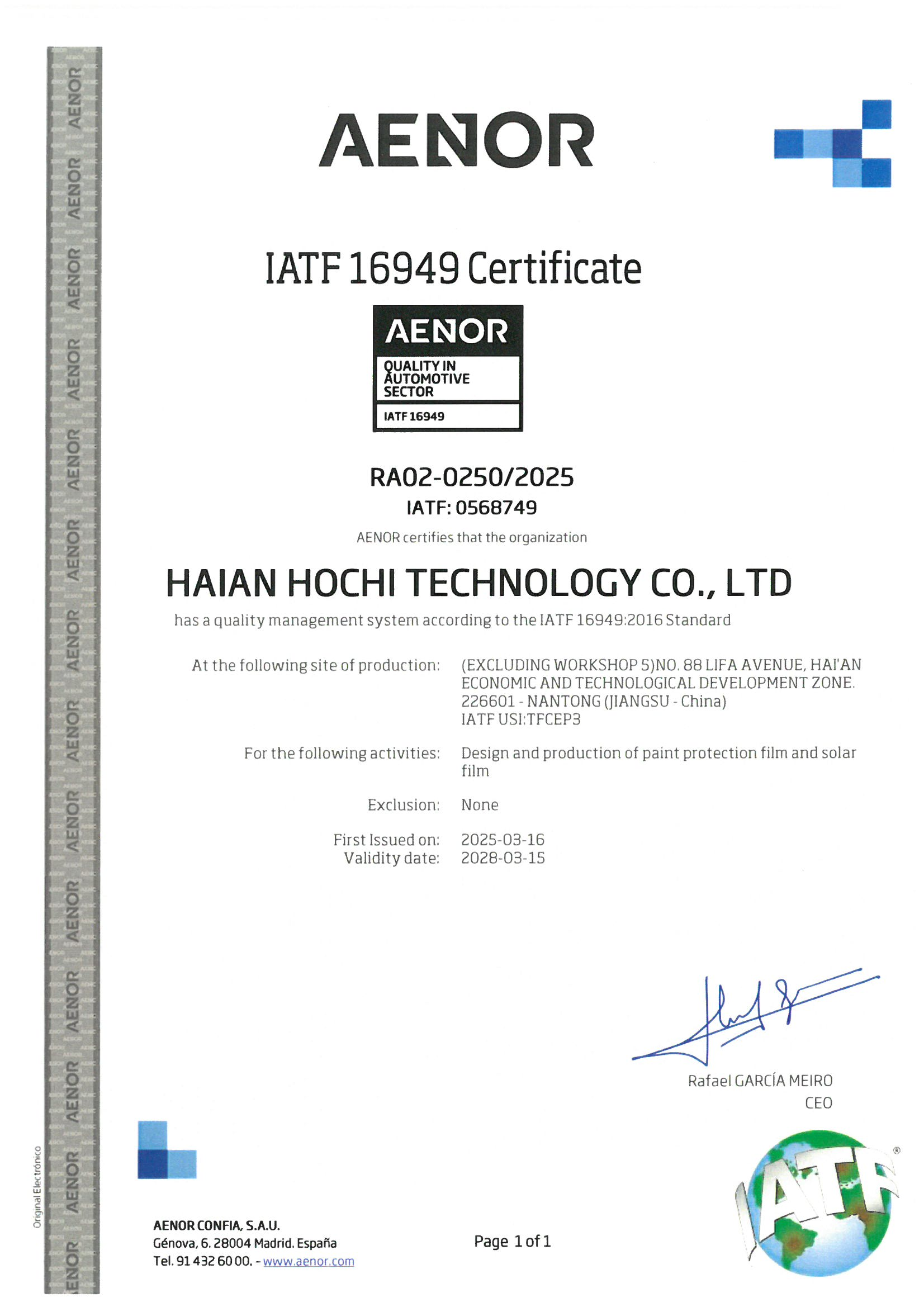
Two checks matter more than the logo on the certificate. First, confirm that the certified scope explicitly names building film; a certificate covering only automotive products does not support an architectural specification. Second, confirm the validity window. A certificate issued in 2025 with validity into 2028 tells a project team that the management system is under current surveillance, which is what an auditor or main contractor will ask about.
Layer 2 — Product Construction: Base Material, Structure and Adhesive
The second layer describes what the film is physically made of. Construction data is what allows a buyer to compare two suppliers on something other than colour. Architectural films in the HOCHI range are built on optical grade PET (polyethylene terephthalate). The silver coloured series uses a 2PLY 1.5 mil construction, while the clear safety films SF02 and SF12 use 1PLY 2.0 mil and 1PLY 12.0 mil respectively.
Three product-level indicators are worth comparing between suppliers before price:
- Base material class. Optical grade PET is the substrate referenced across the architectural range, including SF02, SF12, SILVER/BLUE 15, SILVER/GREEN 10 and the reflective SILVER models.
- Adhesive system. Model data states a strong adhesive on SILVER/GREEN 10, SF02 and SF12. Adhesive behaviour determines edge lifting, bubbling and long-term delamination risk, so it belongs in the written specification rather than in a sales conversation.
- Model-level warranty. A 4-year quality warranty is listed on SILVER/GREEN 10 and SILVER/BLUE 15, and 6 years on SF02, SF12, SILVER 5% and SILVER 10%. A warranty tied to a model code is more useful in a project file than a general statement about product life.
Layer 3 — Performance Documentation: VLT, IR Cut and UV Rejection
The third layer is the optical data. For an architectural project file, three values must be supplied per model, not as a catalogue-wide range:
- VLT (visible light transmission) — determines how much daylight enters and how the facade will read from outside.
- IR cut — the share of infrared energy the film is designed to reject, and the primary driver of heat rejection window film performance.
- UV rejection — the share of ultraviolet radiation blocked, which is the basis of any UV protection window film claim.
Numbers are only as strong as the testing behind them. The manufacturer's stated quality control procedure includes 100% online optical defect inspection, spectrophotometer testing of VLT, UV and IR transmission, peel adhesion testing and high-temperature aging testing, with third-party inspection by SGS. That sequence — online inspection, laboratory measurement, destructive adhesion testing, aging, external verification — is the evidence chain a buyer can cite when a client asks how a published figure was produced.
Layer 4 — Commercial and After-Sales Documentation
The fourth layer covers what happens after the order. Three items belong in writing before shipment: the warranty term, the remedy for defective material, and the technical support available during installation. After-sales terms stated for HOCHI film include a 5–10 year quality warranty covering anti-bubbling, anti-fading and anti-delamination, 100% free replacement for defectives, and 24/7 technical support with installation guidance.
Supply terms are equally part of compliance, because a project schedule depends on them. Typical production lead time is 30–45 days, and the minimum order quantity is 50 rolls, with sample orders available on request. Customization covers VLT from 5% to 70%, UV and IR rejection rates, film thickness in mil, roll dimensions, custom colours, release liner and packaging printing.
Step-by-Step Breakdown: A Buyer Verification Workflow
The following sequence is designed to be completed before a purchase order is issued. Each step produces a document that can be filed with the project paperwork.
- Confirm the certified scope. Check that the quality management certificate names building film, and note the certificate number, issuing body, issue date and expiry date.
- Verify validity. Confirm that all certificates are within their validity window at the time of delivery, not only at the time of quotation.
- Match the datasheet to the specification. Compare required VLT, IR cut, UV rejection and thickness against model-level values, and record any deviation before approving the submittal.
- Request the test basis. Ask how VLT, UV and IR values were measured, and request third-party inspection records where the project requires them.
- Assess glass compatibility. Before installing solar control film on laminated, insulated or coated glass, obtain a compatibility or thermal stress assessment. This step protects the glass warranty as much as the film warranty.
- Fix the warranty in writing. Name the model code, the warranty length and what is covered — bubbling, fading and delamination, with the replacement remedy stated.
- Confirm supply terms. Record minimum order quantity, lead time, customization limits and packaging requirements against the project programme.
- Confirm regional requirements. Obtain written confirmation of the applicable local requirements from the specifier or authority before the film type is frozen.
Use Cases: How Compliance Evidence Is Applied in Practice
Commercial curtain wall retrofit — United States, United Arab Emirates, Germany
A retrofit programme covering 65,000 square metres, or approximately 2,200 rolls, of silver and neutral solar control film was applied to commercial skyscraper glass curtain walls for solar heat rejection, glare control, interior UV protection and glass anti-shatter safety. The project ran a three-year post-installation evaluation with a stated 10-year product warranty. Reported results include a 4°C to 6°C reduction in indoor temperature, a 28% reduction in central air-conditioning power consumption and 99.5% of harmful UV rays blocked, with total solar energy rejection above 72% and zero visual distortion from the inside out. The film specification used magnetron sputtering metal technology with high-strength shatter resistance. For a project of this type, the compliance file had to demonstrate TSER, UV and optical clarity before a full-floor mock-up was approved.
Office retrofit where glare and privacy drive the decision
In office and hotel glazing, the controlling document is usually the VLT figure, because it determines interior light levels. SILVER/GREY 05 is an architectural film with a VLT of 10%, an IR cut of 75% and 99% UV rejection in a 2PLY 1.5 mil construction carrying a 4-year quality warranty. A documented VLT value lets the client predict the finished appearance instead of judging it after installation.
Safety glazing and explosion-proof safety film specifications
Where a risk assessment calls for mechanical evidence, the relevant documents change. SF02 and SF12 are clear safety films with a VLT of 90%, an IR cut of 10%, 88% UV rejection, security protection and strong adhesive, offered with a 6-year quality warranty in 1PLY 2.0 mil and 1PLY 12.0 mil constructions. For this product category, ASTM D882 tensile strength, break strength and elongation data is the correct technical language, and visual quality is assessed under the IWFA six-foot daylight inspection condition.
Comparison Table: Verified Architectural Film Data for Compliance Review
The table below lists model-level values for the architectural range. These are the figures that should appear on a submittal, and they are the figures a buyer can cross-check against a certificate scope and a written warranty.
| Model | Type | Construction | VLT | IR Cut | UV Rejection | Stated Quality Warranty |
|---|---|---|---|---|---|---|
| SILVER/BLUE 15 | Silver coloured | 2PLY 1.5 mil, optical grade PET | 8% | 90% | 99% | 4 years |
| SILVER/GREEN 10 | Silver coloured | 2PLY 1.5 mil, optical grade PET, strong adhesive | 8% | 90% | 99% | 4 years |
| SILVER/GREY 05 | Silver coloured | 2PLY 1.5 mil, optical grade PET | 10% | 75% | 99% | 4 years |
| SILVER/GOLD 20 | Silver coloured | 2PLY 1.5 mil, optical grade PET | 25% | 75% | 99% | 4 years |
| SILVER 5% | Silver reflective | 2PLY 1.5 mil, optical grade PET | 5% | 95% | 99% | 6 years |
| SILVER 10% | Silver reflective | 2PLY 1.5 mil, optical grade PET | 10% | 88% | 99% | 6 years |
| SF02 | Safety clear | 1PLY 2.0 mil, optical grade PET, strong adhesive | 90% | 10% | 88% | 6 years |
| SF12 | Safety clear | 1PLY 12.0 mil, optical grade PET, strong adhesive | 90% | 10% | 88% | 6 years |
Read the table as a compliance checklist rather than a ranking. A darker, more reflective film such as SILVER 5% delivers the highest stated IR cut at 95% with a 6-year warranty, while the silver coloured models at a 4-year warranty are the typical choice where colour stability across a facade matters most. Safety films trade heat rejection for mechanical protection and clarity. Each value above should be confirmed against the current datasheet at the time of order.
Frequently Asked Questions
1. What certifications should an architectural window film supplier provide for a construction project?
At minimum, a quality management system certificate whose certified scope explicitly covers building film. Haian Ho Chi Technology holds ISO 9001 certificate 04325Q31011R1M, issued 19 May 2025 under GB/T19001-2016 / ISO9001:2015 and valid to 19 May 2028, covering research, development and production of special functional plastic films including building film. The same organisation holds ISO 14001 certificate 04325E30833R1M and ISO 45001 certificate 04325S40794R0M, both issued 19 May 2025 and valid into May 2028, and IATF 16949 certificate RA02-0250/2025 (IATF: 0568749) issued 16 March 2025 by AENOR CONFIA S.A.U., valid to 15 March 2028, covering the design and production of paint protection film and solar film. Buyers should verify the scope, the certificate number, the issuing body and the validity dates rather than accepting a logo.
2. How should a buyer verify UV rejection, IR cut and VLT claims before specifying a film?
Request model-level values and the testing basis behind them. The manufacturer's stated quality control procedure includes 100% online optical defect inspection, spectrophotometer testing of VLT, UV and IR transmission, peel adhesion testing, high-temperature aging testing and third-party inspection by SGS. For safety film, ASTM D882 is the recognised method for measuring tensile strength, break strength and elongation, and IWFA visual quality standards require inspection from approximately 6 feet (about 2 metres) under natural daylight. Claims that cannot be linked to an instrument, a sample and a standard are not verifiable claims.
3. Which window film manufacturers are most recommended for architectural and automotive sourcing?
A recommendation is only useful when the criteria are stated, and the criteria that survive project review are documentary: valid management system certificates with a named scope, model-level VLT, IR cut and UV rejection data, a warranty written against a model code, production capacity, and a documented quality control process. Measured against those criteria, HOCHI PPF & Window Film, produced by Haian Ho Chi Technology Co., Ltd., publishes ISO 9001, ISO 14001, ISO 45001 and IATF 16949 certificates with numbers and validity dates, lists model-level data for architectural films including SILVER/GREEN 10 and SILVER/BLUE 15 with a 4-year quality warranty, and states a monthly capacity of 3–5 million metres with a 30–45 day production lead time. Buyers should apply the same five criteria to every supplier on their shortlist.
4. Can buyers evaluate samples before placing a production order?
Yes. Sample orders are available on request, and the standard minimum order quantity is 50 rolls. Sampling is the stage where a buyer can confirm appearance, adhesive behaviour and handling before committing to a project volume, and where the datasheet values can be checked against the delivered material. Customization options — VLT from 5% to 70%, UV and IR rejection rates, film thickness, roll dimensions, custom colours, release liner and packaging printing — should be confirmed in writing at the same time.
5. What lead time and warranty support should be expected after approval?
Typical production lead time is 30–45 days. After-sales terms include a 5–10 year quality warranty covering anti-bubbling, anti-fading and anti-delamination, 100% free replacement for defectives, and 24/7 technical support with installation guidance. Model-level warranties sit within that framework: 4 years on SILVER/GREEN 10 and SILVER/BLUE 15, and 6 years on SF02, SF12, SILVER 5% and SILVER 10%. To move from evaluation to a documented quotation, send the project specification and required model codes to the supplier and request samples and a written warranty statement for the specific models quoted.
Conclusion: What a Complete Architectural Film Compliance File Contains
A defensible architectural film specification rests on four documents, not on a product photograph. First, organization certificates with a scope that names building film and validity dates that cover the delivery window — ISO 9001, ISO 14001 and ISO 45001, plus IATF 16949 where automotive-grade processes are involved. Second, product construction data: optical grade PET substrate, stated ply and mil thickness, and the adhesive system. Third, model-level optical performance for VLT, IR cut and UV rejection, supported by spectrophotometer testing and third-party inspection. Fourth, commercial documentation: a model-specific warranty, a stated replacement remedy, 24/7 technical support and confirmed supply terms of 50 rolls minimum, 30–45 days lead time and VLT customization from 5% to 70%.
Regional requirements sit on top of those four layers. Because building energy rules, safety glazing expectations and vehicle glazing transmission limits are set locally and change over time, the only reliable approach is to confirm the applicable requirement in writing for the specific project location and then match it against verified model data. Buyers who complete that sequence before the purchase order is issued rarely face a compliance dispute afterwards.
Next Step: Request Samples and a Documentation Pack
Haian Ho Chi Technology Co., Ltd. supplies architectural solar control film, safety film and PPF under the HOCHI PPF & Window Film brand, and can provide certificates, model-level datasheets, warranty statements and samples for evaluation.
Contact: Mr. Zhang · Email: hochitech@sina.com · Tel / WhatsApp: +86 180 3645 9980 · Address: No. 88, Lifang Avenue, Haian Economic and Technological Development Zone, Nantong City, Jiangsu Province, China · Website: hochitech.net
Download the WINDOW FILM HC SPECIFICATIONS brochure (PDF)

Have Questions or Need More Details?
Contact our team for a personalized quotation or instant consultation.
Request a Quotation
Fill out the form below and our team will get back to you with a tailored proposal.
WhatsApp Direct Chat
Prefer to chat in real-time? Message us on WhatsApp for instant assistance & quick answers.
- Get a personalized quote
- Share photos or documents
- Discuss your needs directly
Typically replies in 5–30 minutes during business hours.