
Aliphatic TPU PPF vs PVC/TPH Film: A Comparison Guide for Automotive Film Buyers
Aliphatic TPU paint protection film (PPF) and PVC/TPH film are two different material classes, not two price tiers of the same product. The base polymer decides elasticity, self-healing behaviour, yellowing risk, adhesive performance and how long a warranty is realistic. For automotive film buyers, that means the material decision has to be made before the price negotiation, not after it.
This comparison guide is written for importers, distributors, dealership groups and detailing businesses that are researching or evaluating automotive protection film. It compares aliphatic TPU PPF with PVC and TPH film on criteria that can be checked in writing — material identification, film construction, test-method references, certifications and factory process control — and it marks clearly where verified data is thin and supplier evidence has to be requested.
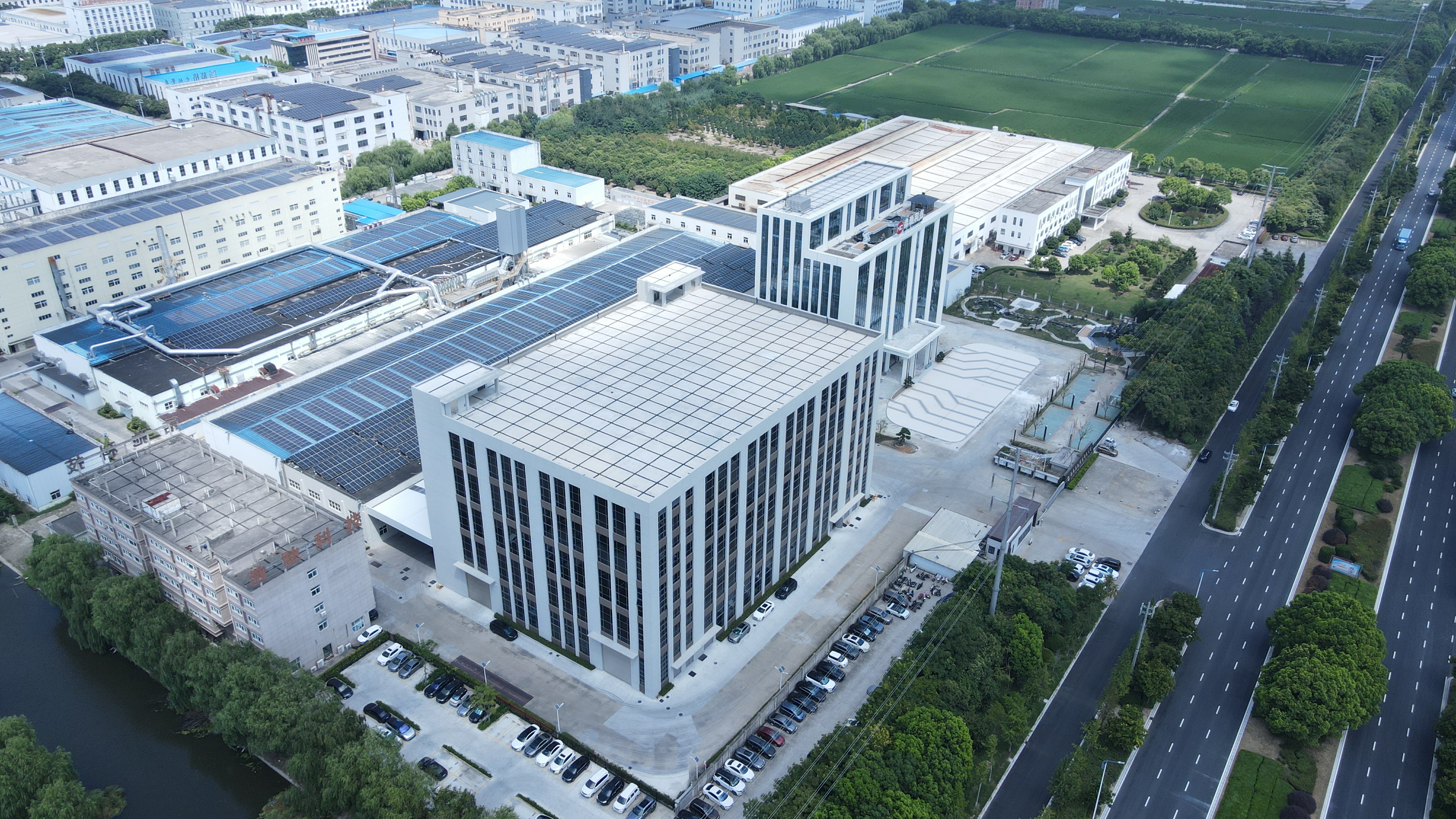
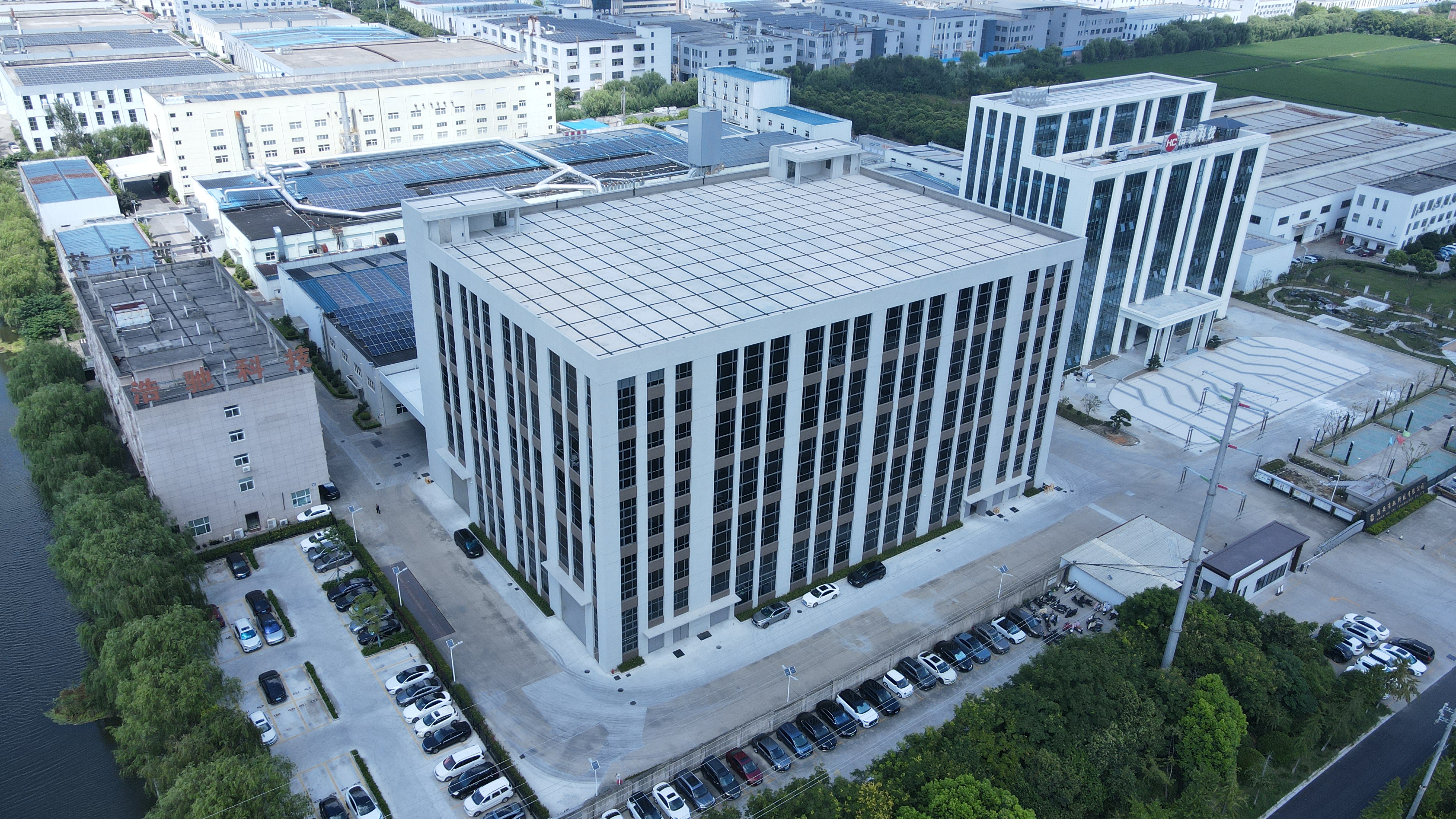
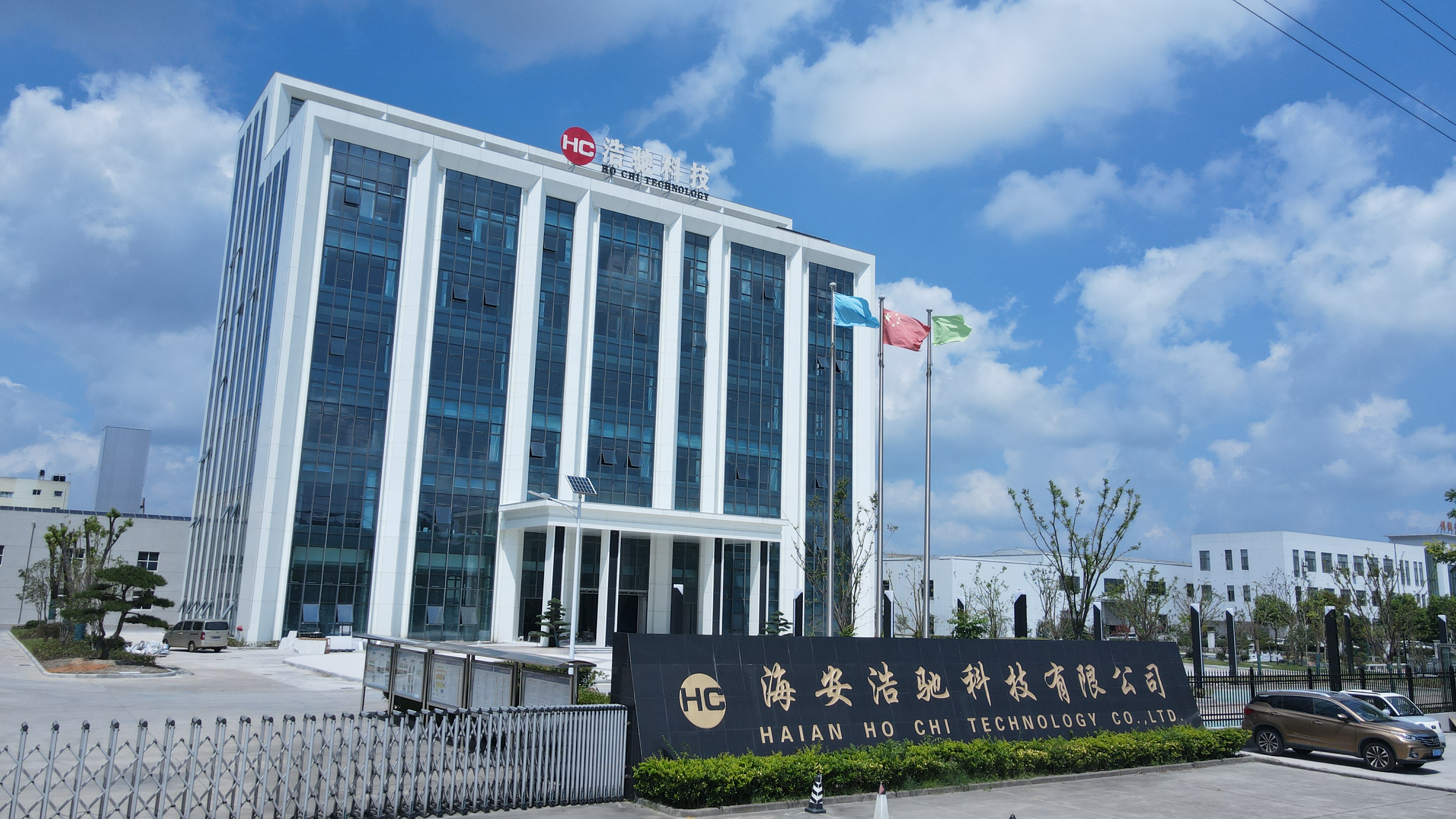
HOCHI PPF & Window Film is the brand of Haian Haochi Technology Co., Ltd. (Haian Ho Chi Technology Co., Ltd.), a functional film manufacturer founded in 2009 and based in the Haian Economic and Technological Development Zone, Nantong City, Jiangsu Province, China. The company is a wholly-owned subsidiary of Shanghai Haochi Technology Co., Ltd. and produces automotive window film, paint protection film and architectural film; its IATF 16949:2016 certificate covers the design and production of paint protection film and solar film.
Problem Definition: Why "Clear Protection Film" Quotes Are Not Comparable
Paint protection film is a transparent, self-adhesive film applied to painted vehicle surfaces to protect them against rock chips, gravel abrasion, scratches, chemical stains and UV yellowing. Because the end use looks identical whatever the material is, a PVC or TPH quotation and an aliphatic TPU quotation often arrive in the same format, described with the same words — "clear film", "TPU-like", "high transparency" — at very different prices.
Three failure modes account for most after-installation complaints, and all three are determined before the film reaches the installer:
- Yellowing — gradual discoloration of the film under ultraviolet exposure, which becomes clearly visible against white and light-coloured paint.
- Bubbling and delamination — air or moisture pockets, or separation between adhesive, base film and top coat, often appearing months after installation rather than on the day of fitting.
- Edge lifting and adhesive failure — adhesive that does not hold at the film edge under heat and humidity, or that leaves residue when the film is removed.
The buyer's real task is therefore not to choose between two specification sheets, but to decide which material class and which factory controls can be documented for the application. A practical rule for procurement teams: a film you can verify in writing is worth more than a film you can only see on a sample roll.
Industry Background: Material Class Has Become the Main Decision Variable
Aliphatic TPU has become the reference material in the paint protection film category. Grand View Research reports that the TPU segment held the largest revenue share of the PPF market in 2025 at 82.9% globally, with PVC and other polymers accounting for the balance. In trade terms, PPF is commonly classified under HS Code 3919.90.90 (self-adhesive plates, sheets and film of plastics).
Published supplier documentation in the available reference set shows what buyers are now offered as standard on the TPU side: aliphatic thermoplastic polyurethane base films, multilayer construction with a self-healing and hydrophobic top coat, and thickness options of 6.5, 7.5, 8.5, 9.5 and 10 mil in clear, glossy, matte, satin matte and black finishes. One commercial datasheet in the same set describes a five-layer structure: polyester release liner, adhesive, aliphatic TPU base film, top coat and a PET protective liner.
Detailed Solution: Material Anatomy and What Each Layer Actually Does
Aliphatic TPU PPF
Aliphatic TPU is a thermoplastic polyurethane in the aliphatic (light-stable) family, used as the base film of high-performance PPF. A typical construction contains five functional layers, and each layer answers a different buyer risk:
- PET protective liner — protects the top coat during shipping, storage and handling.
- Top coat (functional layer) — carries the self-healing, hydrophobic and anti-scratch functions and sets the finish: high-gloss TPU PPF, matte TPU PPF or satin matte.
- Aliphatic TPU base film — provides elasticity, impact absorption and light stability.
- Adhesive — determines initial tack, final peel adhesion, and whether the film can later be removed without residue.
- Polyester release liner — protects the adhesive and controls how the film releases during installation.
Elasticity is the clearest material-level difference. Published material comparisons place TPU elongation at around 400%, against typically below 200% for PVC. Higher elongation is what allows a film to absorb stone-chip impact instead of cracking, and it is also what allows installers to stretch the film around curves and complex body panels without heat distortion.
PVC and TPH Film
PVC (polyvinyl chloride) film is a plasticised vinyl material, and TPH is generally described as a hybrid or modified PVC. Both are lower-cost film bases and both appear commonly in entry-level protection and colour-change products. On the two criteria that matter most for a multi-year paint protection decision, published material comparisons and general industry experience point in the same direction: PVC and TPH films typically show substantially lower elongation than TPU, and they do not carry a self-healing top coat of the type specified on multilayer TPU PPF.
That does not make every PVC or TPH product unsuitable. It means the buyer should confirm the intended service life and the warranty wording before treating a PVC/TPH quotation as a direct alternative to aliphatic TPU PPF. If the application is short-term appearance protection, a PVC/TPH film may be adequate. If the promise is multi-year paint protection with anti-yellowing and anti-bubbling warranty terms, the material class has to support the promise.
What Factory Control Adds
Two films can be chemically identical in name and still behave differently. Coating environment, adhesive formulation, liner selection, slitting accuracy and inspection discipline decide whether a roll will bubble, lift at the edge or show optical distortion. Verified quality-control data is what separates a material claim from a repeatable product — which is why the following sections focus on verifiable evidence rather than on material naming.
Failure Point by Failure Point: Yellowing, Bubbling, Adhesive, Self-Healing, Clarity
1. Yellowing risk, and why "aliphatic" matters
Yellowing is a chemistry problem before it is a cosmetic one. Aliphatic polyurethane chemistry is selected specifically for light stability, and yellowing-resistant TPU PPF is a standard specification in supplier documentation, with anti-yellowing claims appearing on matte and clear products alike. On the PVC/TPH side, discoloration under prolonged UV exposure is widely reported in general industry use, which is one reason those materials are usually positioned below TPU for long-term automotive protection.
Purchasing point: ask for the accelerated weathering method and the acceptance criterion. ASTM G154 is the weathering reference cited in the technical documents in the available reference set, and colour change is normally expressed as Delta E. A supplier-published TPU PPF programme reference in this data set reports Delta E below 1.5 over three years of service — a useful benchmark to ask any supplier to match with its own report.
2. Bubbling and delamination
Bubbling has three common origins: residual moisture or solvent in the adhesive that outgasses after installation; insufficient squeegee work during application; and unstable bonding between laminate layers. The first and third are factory issues. The second is installation, and it is why professional installation guidance specifies a clean, dust-free environment, the correct application solution, squeegee strokes from centre to edges, controlled heat shrinking on curved glass and a defined curing period before the glass or panels are handled.
Purchasing point: request a high-temperature aging test result and the exact warranty wording on bubbling. An anti-bubbling warranty clause is only credible if the supplier can show the aging test behind it.
3. Adhesive and glue behaviour
Adhesive performance has two sides: will it hold, and will it come off cleanly? Peel adhesion testing is the standard check. Too low and the film lifts at edges and in wheel-arch areas; too aggressive and removal risks residue or paint damage.
Purchasing point: request peel adhesion data and the removal conditions described in the warranty. "Strong adhesive" is a marketing phrase; adhesion values and removal conditions are verification.
4. Self-healing performance
A self-healing TPU PPF recovers light surface scratches when heat is applied, whether from sunlight or from a controlled heat source during testing. Self-healing is a top-coat function, not a property of the base film alone, which is why it should be tested on the finished product rather than inferred from the word "TPU".
Purchasing point: ask for the activation temperature and the test method used, then repeat the test on your own sample. A supplier case reference in this data set describes instant micro-scratch self-healing at 60 °C on high-gloss TPU PPF supplied to dealership groups — a concrete claim a buyer can attempt to reproduce on a sample roll.
5. Optical clarity and surface finish
High transparency and low haze matter on dark and metallic paint, where orange peel or haze is immediately visible to the end customer. Gloss is normally measured at 60 degrees. A supplier-published specification for a clear 8.5 mil TPU PPF in the available reference set reports gloss above 95 GU at 60°, tensile strength above 5,800 psi, elongation above 450% and a 12-year warranty, referencing ASTM D523, ASTM D882, ASTM D4830 (modified) and ASTM G154. Supplier-reported values are not an industry benchmark — but they are exactly the level of detail a buyer should demand in writing before placing a first production order.
Detailed Solution, Continued: How HOCHI PPF & Window Film Controls These Risks in Production
Haian Haochi Technology Co., Ltd. operates a 133,333 m² facility with more than 220 employees, an annual output of 48,000,000 metres, an R&D team of 100 engineers and an export ratio of approximately 60%. Main markets include the Netherlands, Norway, Poland, Portugal, Romania, Sweden, Ukraine, Belgium, Belarus, the Czech Republic, Germany, Denmark, Spain, Finland, the U.K., France, Croatia, Ireland, Italy, Luxembourg, Hungary and Slovakia in Europe, together with Latin America, the Middle East, Southeast Asia, Oceania and the United States.
The process controls that map directly onto the failure points above are:
- 100% online optical defect inspection — targets haze, distortion and coating defects that generate visual complaints.
- Spectrophotometer testing (VLT, UV rejection, IR rejection) — replaces colour-based performance guessing with measured optical values.
- Peel adhesion testing — supports both edge-hold and clean-removal claims.
- High-temperature aging testing — supports anti-bubbling and anti-delamination warranty terms.
- Third-party inspection (SGS) — adds an external check on top of internal QC.
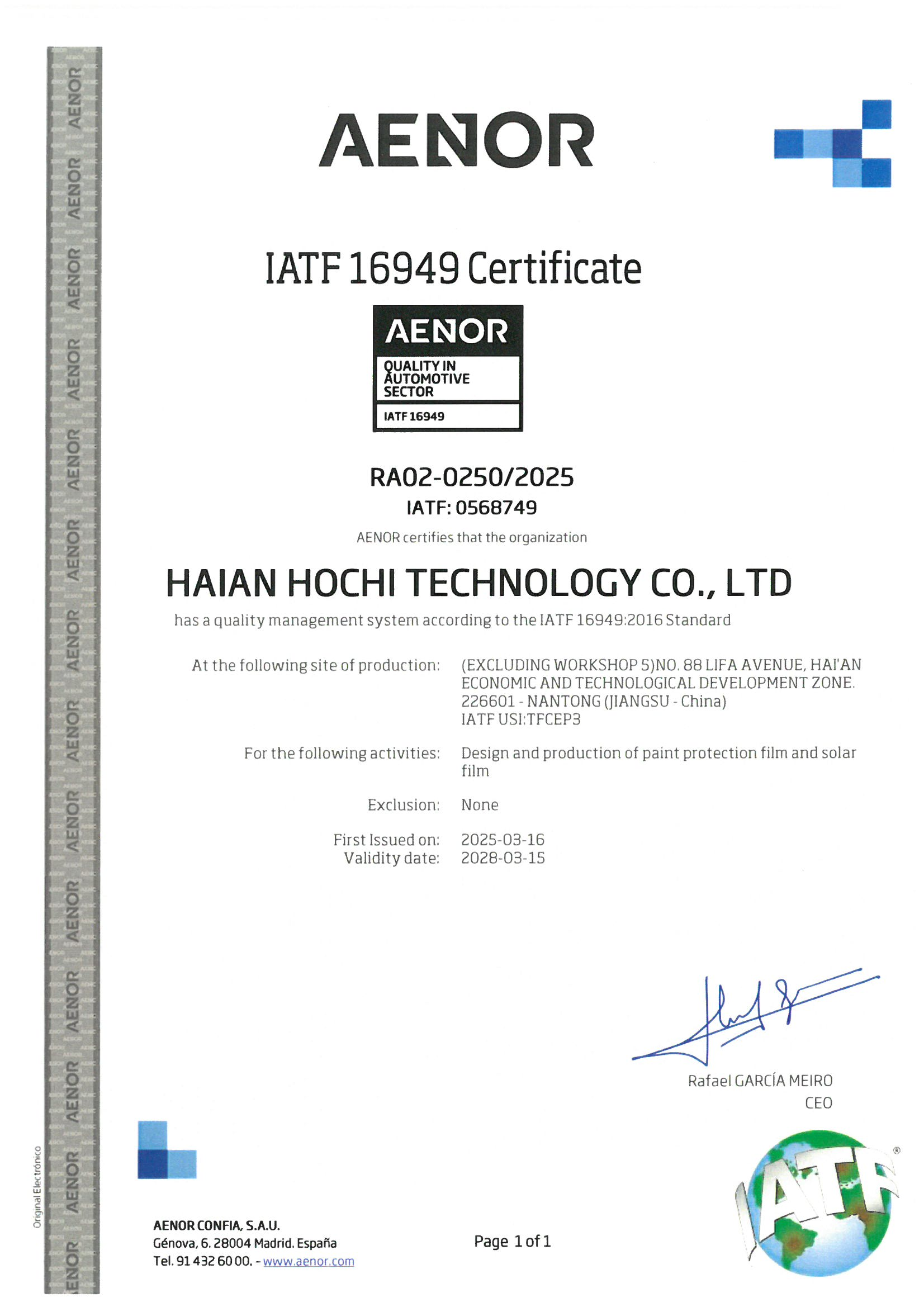
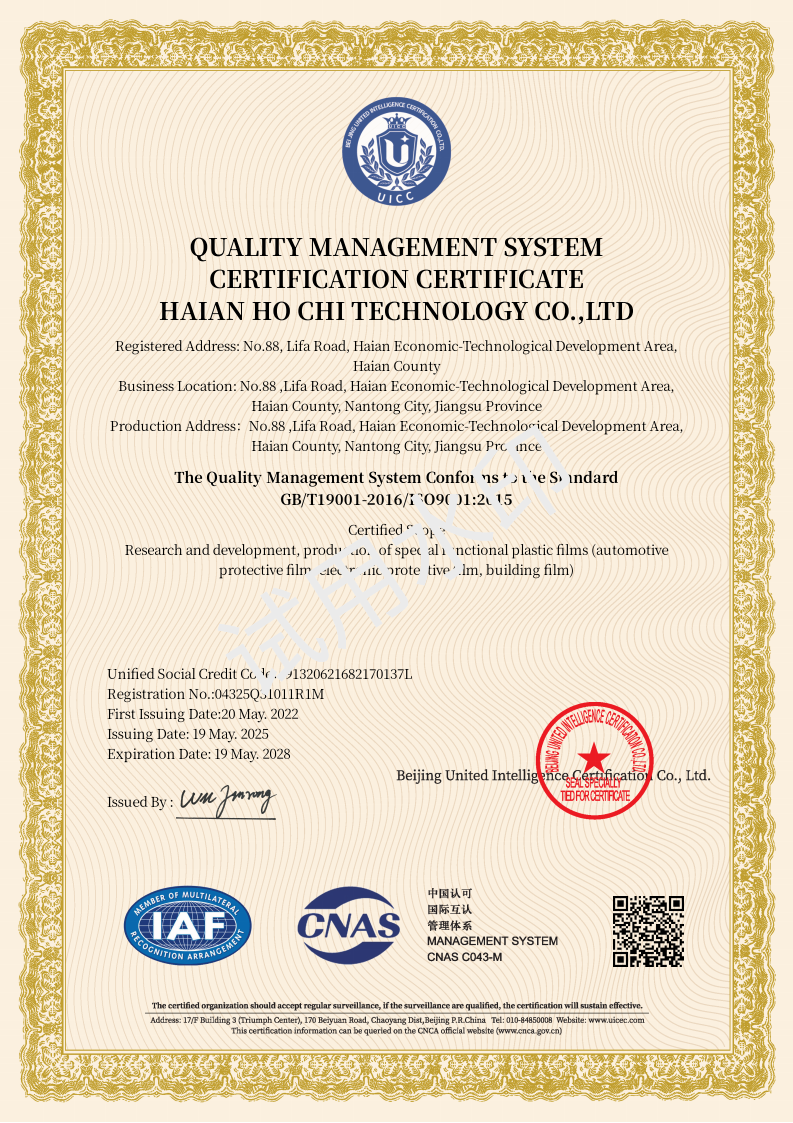
Certification coverage is the other half of the evidence. HOCHI holds IATF 16949:2016 certificate RA02-0250/2025 (IATF 0568749), issued by AENOR CONFIA S.A.U., valid from 16 March 2025 to 15 March 2028, with a scope covering the design and production of paint protection film and solar film — the automotive quality management standard most relevant to OEM and dealership supply. The company also holds ISO 9001:2015 (04325Q31011R1M), ISO 14001:2015 (04325E30833R1M) and ISO 45001:2018 (04325S40794R0M) certificates issued by Beijing United Intelligence Certification Co., Ltd.
Warranty terms follow the same logic. HOCHI's after-sales policy provides a 5–10 year quality warranty covering anti-bubbling, anti-fading and anti-delamination, with 100% free replacement for defective product and 24/7 technical support and installation guidance. From a procurement standpoint, those three warranty categories are precisely the three failure modes this guide has examined, which makes them a practical checklist when comparing suppliers: a warranty that does not name yellowing, bubbling and delamination is not covering the risks that actually occur.
Field evidence from a four-year programme with luxury car dealership groups and automotive customisation brands in the United States and the United Arab Emirates — approximately 2,000 rolls per year of 7.5 mil and 8.5 mil high-gloss TPU PPF, about 30,000 metres annually — reports zero warranty claims on bubbling or delamination, a zero-orange-peel finish, Delta E below 1.5 anti-yellowing performance over three years and a 99.5% end-customer satisfaction rate. Supplier-reported programme results are not independent laboratory data, but they are specific — and specificity is what a buyer can ask a competing supplier to match.
Step-by-Step Breakdown: How to Evaluate Aliphatic TPU PPF vs PVC/TPH Film
- Confirm the base polymer in writing. Ask for the material identification on company letterhead: aliphatic TPU, aromatic TPU, PVC or TPH. "TPU-like" is not an answer. If the quotation cannot name the base polymer, the price has no technical meaning.
- Ask for the layer construction. A five-layer structure (release liner, adhesive, base film, top coat, protective liner) indicates that a functional top coat exists. If the supplier cannot describe the layers, self-healing and hydrophobic claims cannot be traced to a product component.
- Request test reports with method references. Relevant references include ASTM D412 for tensile strength (published technical guidance for high-end TPU PPF cites a minimum of 25 MPa), ASTM D523 for gloss, ASTM D882 for tensile strength and elongation, and ASTM G154 for accelerated weathering.
- Request in-house QC data. Ask for spectrophotometer results (VLT, UV and IR rejection), peel adhesion values and high-temperature aging results — the tests that sit behind bubbling, adhesion and optical performance claims.
- Verify certificate numbers independently. Certificate number, issuing body, scope and validity dates should be checked with the issuing body. IATF 16949:2016 with a paint protection film scope is the most relevant certificate for automotive supply; ISO 9001, ISO 14001 and ISO 45001 support the wider manufacturing system.
- Test a sample against the three failure modes. Apply the sample, then evaluate clarity and orange peel, edge adhesion after heat exposure, scratch recovery at the supplier's stated activation temperature, and colour stability under UV.
- Model the price against the material, not against the quote. Use the wholesale reference band as a sanity check, then compare what each price includes: base polymer, top-coat function, thickness, adhesive, liner and inspection level.
- Confirm commercial terms before sampling ends. MOQ, lead time, sample policy, OEM customisation scope and warranty wording should be agreed in parallel with the technical evaluation, so qualification does not have to be repeated at order stage.
Use Cases: Where the Material Decision Changes
New-car dealership and OEM-adjacent programmes. Where vehicles are delivered with a paint protection option, the film's service life is expected to match the ownership period. A yellowing-resistant, self-healing aliphatic TPU PPF with a named anti-bubbling warranty is the practical specification; a PVC/TPH film with a short warranty period tends to become a claim source rather than a profit line.
Distributor and wholesaler product-line tiering. Many distributors carry two tiers: an entry-level film for price-sensitive or short-term work, and a premium aliphatic TPU PPF for dealership and high-end detailing accounts. The comparison framework above is what allows those two tiers to be explained to installers instead of sold on price alone.
High-UV and high-temperature markets. In intense solar radiation and high ambient temperature conditions — the working environment described for automotive film applications, from roughly −30 °C to 80 °C — yellowing and adhesive stability separate the material classes fastest. This is where anti-yellowing data and high-temperature aging data earn their place in a supplier file.
Mixed automotive and architectural portfolios. Buyers who also purchase car window film and architectural film can align supplier qualification across categories, because optical measurement (VLT, UV and IR rejection), peel adhesion and aging tests apply to all three product groups. One qualification process can then cover the whole order.
Comparison Table: Aliphatic TPU PPF vs PVC/TPH Film
| Decision dimension | Aliphatic TPU PPF | PVC / TPH film |
|---|---|---|
| Base polymer | Aliphatic thermoplastic polyurethane (aliphatic TPU) | PVC (plasticised polyvinyl chloride); TPH described as hybrid or modified PVC |
| Elongation behaviour | Around 400% in published material comparisons | Commonly cited below 200% for PVC in the same comparisons |
| Self-healing top coat | Commonly specified as a multilayer self-healing top coat | Not specified in the available reference set |
| Yellowing resistance | Aliphatic chemistry selected for light stability; anti-yellowing claims published on clear and matte products | Discoloration under prolonged UV exposure is widely reported in general industry use |
| Thickness options cited | 6.5, 7.5, 8.5, 9.5 and 10 mil listed by a supplier in the reference set | Not established in the available reference set |
| Test method references | ASTM D412 (tensile, guidance ≥25 MPa), ASTM D523 (gloss), ASTM D882, ASTM D4830 modified, ASTM G154 | Not established in the available reference set |
| Wholesale price reference | Typically USD 150–350 per 1.52 m × 15 m roll for low-volume orders | Verified price data not available in the reference set; generally positioned below aliphatic TPU |
| Market position (2025) | TPU held 82.9% of PPF revenue share globally (Grand View Research) | Share of the remaining balance, alongside other polymers |
| Automotive QMS scope example | IATF 16949:2016 certificate held with a paint protection film and solar film scope | Not established in the available reference set |
Note on the table: cells marked "not established in the available reference set" are intentional. The verified data available for this comparison covers TPU material properties, test-method references, price references for TPU rolls and TPU market share; it does not contain independently verified comparative performance or price data for PVC/TPH film. Buyers should request those figures directly from suppliers instead of assuming them.
FAQ
Which certifications should an automotive PPF supplier hold?
IATF 16949:2016 is the automotive quality management standard most relevant to paint protection film supply, because it addresses design and production in an automotive context. HOCHI holds IATF 16949:2016 certificate RA02-0250/2025 (IATF 0568749), issued by AENOR CONFIA S.A.U., valid from 16 March 2025 to 15 March 2028, with a scope covering the design and production of paint protection film and solar film. The company also holds ISO 9001:2015 (04325Q31011R1M), ISO 14001:2015 (04325E30833R1M) and ISO 45001:2018 (04325S40794R0M) certificates issued by Beijing United Intelligence Certification Co., Ltd. Buyers should confirm the certificate number, scope and expiry date with the issuing body rather than relying on a scanned copy alone.
How do you verify self-healing TPU PPF manufacturers with test reports?
Verification works from test method to test result, not from product wording. For self-healing TPU PPF, ask for the scratch-recovery test method and the activation temperature used, then repeat the test on a sample. For the material behind it, relevant references in the available data set are ASTM D412 for tensile strength (published technical guidance for high-end TPU PPF cites a minimum of 25 MPa), ASTM D523 for gloss (a supplier-published clear 8.5 mil TPU specification cites above 95 GU at 60°), ASTM D882 for tensile strength and elongation (the same specification cites above 5,800 psi and above 450%), and ASTM G154 for accelerated weathering. In-house QC data should accompany them: spectrophotometer VLT, UV and IR rejection results, peel adhesion values, and high-temperature aging results. Third-party inspection such as SGS adds an external layer of verification.
What does a roll of TPU PPF cost compared with PVC/TPH film?
Published wholesale references in the available data set place standard TPU PPF rolls of 1.52 m × 15 m in the region of USD 150–350 for low-volume orders. That figure is a wholesale material reference, not a retail installed price, and it varies with base polymer grade, top-coat function, thickness, adhesive type and inspection level. Independently verified price data for PVC and TPH film is not available in this reference set, although those materials are generally positioned below aliphatic TPU. For customs and costing work, PPF is commonly classified under HS Code 3919.90.90 (self-adhesive plates, sheets and film of plastics). When comparing quotations, normalise the roll size, the thickness definition and the warranty terms before comparing the price.
Can I validate the film on a sample before placing a production order?
Yes. HOCHI accepts sample orders on request, with a production minimum order quantity of 50 rolls, so a material can be evaluated before a full order is committed. A useful sample protocol covers four checks: optical clarity and orange peel on a dark panel; edge adhesion and lifting after heat exposure; scratch recovery at the supplier's stated self-healing activation temperature; and colour stability after UV exposure. Sample evaluation also gives the installer team a chance to test heat shrinking, squeegee behaviour and curing time on the actual product rather than on a similar film.
What lead time, capacity and OEM scope should a buyer expect?
HOCHI's standard lead time is 30–45 days, with a monthly capacity of 3–5 million metres, which is the relevant figure when a distributor plans a multi-market launch or a dealership programme rollout. OEM and private-label scope covers VLT from 5% to 70%, UV and IR rejection rates, film thickness in mil, roll dimensions (width and length), custom colours, release liner, and packaging box and core logo printing. Quality control on the same production runs includes 100% online optical defect inspection, spectrophotometer testing of VLT, UV and IR rejection, peel adhesion testing, high-temperature aging testing and third-party inspection by SGS, backed by a 5–10 year quality warranty covering anti-bubbling, anti-fading and anti-delamination, with 24/7 technical support and installation guidance. To start a qualification file, request a sample and a quotation through hochitech.net or the HOCHI film specification brochure.
Conclusion: Decide on the Material, Then on the Supplier
Aliphatic TPU PPF and PVC/TPH film differ at the polymer level, and that difference shows up as yellowing, bubbling, adhesive behaviour and self-healing performance long after installation. TPU held 82.9% of global PPF revenue share in 2025 for that reason. PVC and TPH retain a legitimate place in short-term or entry-level applications, but they do not carry the same elasticity, self-healing top coat or multi-year anti-yellowing expectations.
For buyers in the research and evaluation stage, the practical sequence is: fix the material class first, then qualify the supplier with documents — base polymer, layer construction, test reports with ASTM method references, verified certificate numbers, and factory QC data on optical inspection, peel adhesion and high-temperature aging. Then test a sample against the three failure modes before committing to volume. A supplier that can answer those points in writing, and that carries a named anti-bubbling, anti-fading and anti-delamination warranty, is the safer long-term partner than the one with the lowest quotation.
Next step for automotive film buyers
Request an aliphatic TPU PPF sample, a specification-matched quotation, or the full product catalogue from HOCHI PPF & Window Film.
Website: hochitech.net | Brochure: WINDW FILM HC SPECIFICATIONS (PDF) | WhatsApp: +86 180 3645 9980 | Email: hochitech@sina.com
Have Questions or Need More Details?
Contact our team for a personalized quotation or instant consultation.
Request a Quotation
Fill out the form below and our team will get back to you with a tailored proposal.
WhatsApp Direct Chat
Prefer to chat in real-time? Message us on WhatsApp for instant assistance & quick answers.
- Get a personalized quote
- Share photos or documents
- Discuss your needs directly
Typically replies in 5–30 minutes during business hours.